

When it comes to child support decisions, Michigan is unique in that it doesn’t give judges much room to improvise. The state uses a mandatory formula, the Michigan Child Support Formula (MCSF), and courts are required to follow it in nearly every case. But that doesn’t mean the number that comes out is automatic or impossible to challenge; the inputs matter enormously, and so does how they’re documented.
If you’re trying to figure out what you’ll owe, what you’ll receive, or whether there’s grounds to change an existing order, understanding how the formula works is the right place to start. Our Metro Detroit-based Michigan child support lawyers are here to break it down.
Key Takeaways: How Michigan Calculates Child Support
- Child support is calculated using the Michigan Child Support Formula (MCSF), an income-shares model that combines both parents' net monthly incomes and adjusts the result based on parenting time overnights, health insurance costs, and childcare.
- Parenting time is calculated by the number of overnights, not percentages of time, which is why custody negotiations and child support orders often go hand in hand.
- After a uniform child support order is placed, either parent can request a review every 36 months, or sooner if there has been a substantial change in circumstances (job loss, income increase, etc).
- Nonpayment of child support in Michigan carries serious consequences, including wage garnishment, license suspension, tax refund interception, and potential felony charges.
What Is the Michigan Child Support Formula?
The MCSF uses what’s called an income shares model. The basic idea is that a child should receive roughly the same proportion of both parents’ income as they would if the family were still living together.
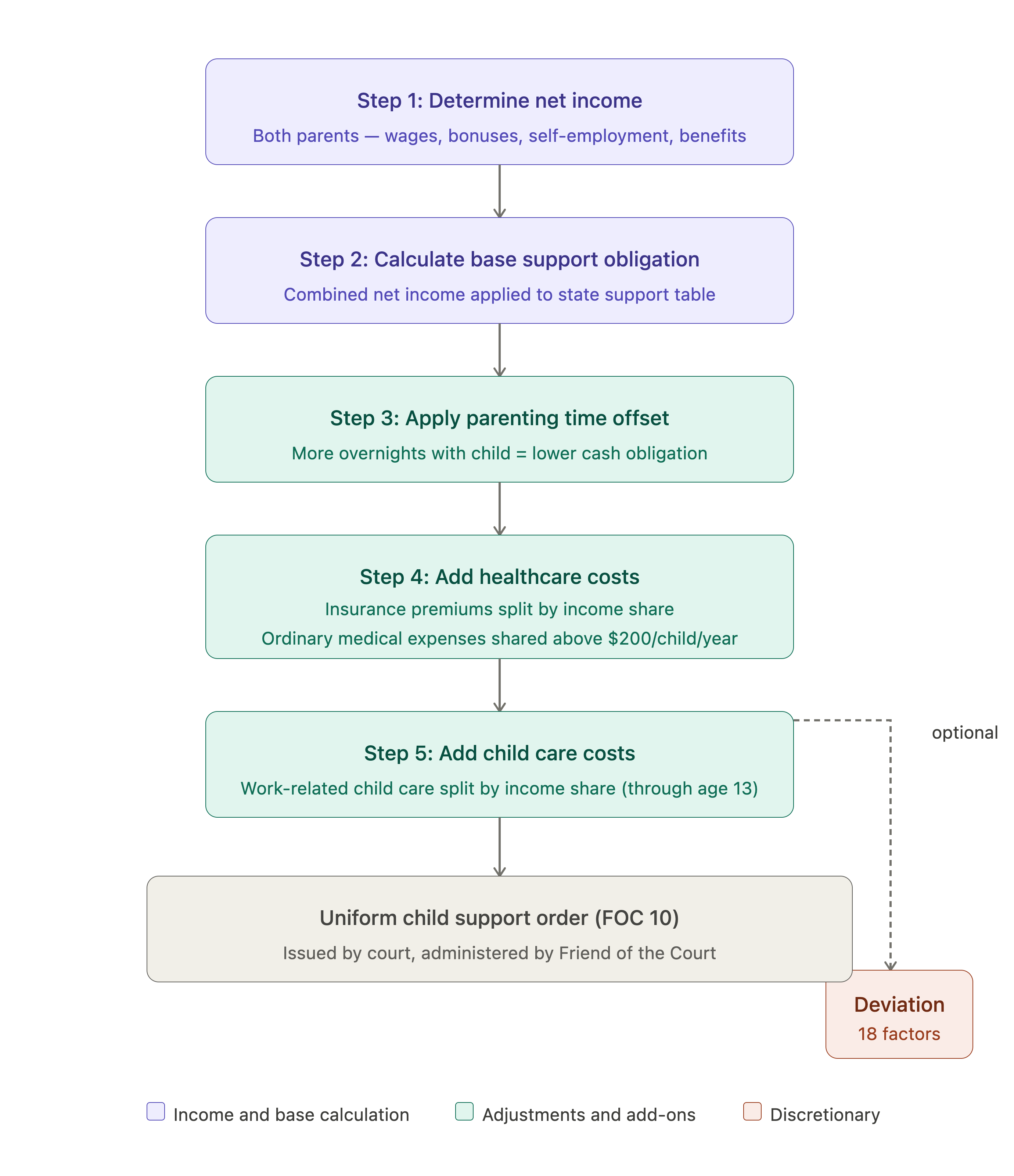
In practice, the family court combines both parents’ net monthly incomes, applies a state-approved support table to determine a base support obligation, and then adjusts that number based on parenting time, health insurance costs, and childcare expenses, all under MCL § 552.605.
The courts have to apply the formula unless specific deviation factors justify a different result (more on that later on).
The Role of the Friend of the Court
The Friend of the Court (FOC) is the county-level agency that runs this calculation first. Each county in Michigan has an FOC office that handles initial support recommendations, periodic reviews, and enforcement. But its recommendation isn’t a final order. Either parent can object and request a hearing before a judge.
How “Net Income” Is Defined Under the Michigan Child Support Formula
For child support purposes, the MCSF defines net income broadly to capture all regular sources of funds available to a parent. That includes:
- Wages
- Salaries
- Bonuses
- Commissions
- Self-employment earnings
- Rental income
- Investment returns
- Social Security benefits
- Workers’ compensation
- Unemployment
- Retirement distributions
Net income under the MCSF is gross income from all recognized sources minus actual income taxes and other allowable deductions. The idea is to establish as accurately as possible how much money a parent has available for support.
Self-Employment and Business Income
Courts often place self-employed parents under closer scrutiny because tax returns don’t always reflect the full picture. Courts can add back depreciation, examine business-provided perks like a company vehicle, and consider the overall financial picture to determine what a parent actually has available.
If a parent appears to be voluntarily underemployed or reducing their income to minimize support, a court can assign income based on what that person is reasonably capable of earning. This is just one place where strong legal representation from a Michigan child custody lawyer can make a big difference.
How Parenting Time Affects the Amount of Child Support You Pay
Parenting time directly affects child support, and the formula measures it by the number of overnight stays rather than as a percentage. Every additional overnight the paying parent has with the child reduces their cash support obligation, because they’re covering more of the child’s day-to-day costs directly during that time.
Even a difference of 10 overnights per year can significantly affect the monthly payment. This is why custody negotiations and support calculations are often handled together. The formula always sticks to the court-ordered payment schedule, not informal arrangements that change week to week.
Note: Parenting time and child support are enforced separately under Michigan law. A parent who falls behind on paying child support will face enforcement action regardless of whether their parenting time has been honored. That means a custodial parent can’t legally withhold child support payments over missed visitation.
Healthcare, Child Care, and the New Michigan Child Support Law Changes
Beyond base support, the MCSF allocates two additional cost categories between parents: health insurance and child care. Both are divided proportionally based on each parent’s share of combined income.
Health Care Coverage
When a parent carries health insurance that covers the children, the portion of the health insurance premium attributable to the children is factored into the support calculation and divided between the parents. Under Michigan law, coverage is considered reasonable when the cost doesn’t exceed 6% of the support payer’s gross income.
The Ordinary Medical Expense Threshold
This is one of the most significant changes from the 2025 MCSF. Previously, each parent absorbed the first $454 per child per year in ordinary medical costs (things like co-pays, prescriptions, and over-the-counter expenses) before cost-sharing kicked in. That threshold dropped to $200 per child annually starting January 1, 2025.
The practical effect is that more out-of-pocket medical costs are now subject to proportional sharing between parents. If your existing child support order predates January 1, 2025, this change alone could justify requesting a review.
Child Care Costs Through Age 13
Work-related child care costs, including daycare, before- and after-school programs, and summer care needed for a parent to work, are added to the base calculation and divided proportionally. The 2025 update extended that cost-sharing through the end of the month a child turns 13, up from the prior cutoff at age 12.
If you’re paying for child care for a 12-year-old and your order predates this change, it could be worth revisiting.
What Is Child Support Used For?
Child support is designed to cover the child’s total cost of living, across three categories: base support for the child’s general care and needs, medical support, and child care expenses.
In practice, this means everyday costs like:
- Housing
- Food
- Clothing
- Transportation
- School supplies
- Routine medical care
Extraordinary medical, educational, or therapeutic costs are handled separately, either through the formula’s add-on components or through specific court orders.
Michigan law doesn’t require the receiving parent to account for how base support is spent. The presumption is that it goes toward the ordinary cost of raising a child.

When a Judge Can Deviate from the Formula
The formula is there for a reason, but courts can depart from it. Judges may deviate when strict application would produce an unjust or inappropriate result. When this happens, the judge must document both the formula amount and the specific reasons for departing from it.
The 2025 MCSF lists 18 deviation factors, but the list isn’t exhaustive, and courts may consider any factor relevant to the child’s best interests. Also, the existence of a deviation factor doesn’t require a court to change course. It simply opens the door for that to happen.
- Common circumstances where courts deviate include:
- A child with special needs or extraordinary educational expenses
- Significant income imbalance between parents
- A parent carrying extraordinary medical expenses for themselves or a dependent
- Irregular or highly variable bonus income
- Substantial debt obligations affecting available income
- Cases where one parent’s share of child care costs exceeds 50% of their base support obligation
- Property awarded in lieu of support
If you believe the formula produces an unfair result in your situation, a family law attorney can help you build the documentation needed to support or challenge a deviation.
When Child Support Ends in Michigan
Child support generally ends when a child turns 18, specifically at the close of the month in which the 18th birthday falls.
The High School Exception
Support can continue if the child is regularly attending high school full-time, living with the custodial parent, and has a reasonable expectation of completing graduation requirements. Support under this exception can’t extend past the date the child turns 19 years and 6 months old.
This extension also isn’t automatic. The courts will have to look at actual enrollment and graduation trajectory before allowing it.
Support Doesn’t Stop Automatically
Child support doesn’t automatically terminate when a child ages out. Parents should file the appropriate paperwork with the court or FOC office when the obligation ends, rather than just stopping payments and assuming the record updates automatically.
How to Request a Child Support Modification in Michigan
A uniform child support order (UCSO) is a binding legal obligation, so changing it requires a formal court process. Parents can’t just agree between themselves to pay a different amount.
There are two ways to pursue a modification.
- FOC Review: Every parent has the right to request a review from their FOC office once every 36 months. You don’t need to file a motion or pay a filing fee for this.
- File a Motion: You can file a motion to modify support any time by demonstrating a substantial change in circumstances (minor income fluctuations and routine cost-of-living changes generally don’t qualify).
| FOC Review | Motion to Modify | |
| When You Can File | Once every 36 months, by written request to your FOC office | Any time, no waiting period |
| What You Need to Prove | Nothing | A substantial change in circumstances since the last order |
| Filing Fee | None | $60 motion filing fee |
| Who Runs the Process | The FOC Office: they collect income info, recalculate, and file a motion if the number changes | You (or your attorney) file directly with the court; FOC may be involved in review |
| Threshold to Trigger a Change | The new amount must differ from the current order by more than 10% or $50/month | Court's discretion; they must find the current order is unfair given the changed circumstances |
| Best Used When | Your order is 3+ years old, and you want a no-cost recalculation under the current formula | Circumstances have changed significantly, and you can't wait for the 36-month window |
What Happens If Child Support Goes Unpaid
If you miss child support payments in Michigan, enforcement action is triggered automatically. Payments flow through the Michigan State Disbursement Unit, and the FOC flags missed payments quickly.
The state may enforce child support orders in a number of ways:
- Income withholding: Wages are garnished directly from the paying parent’s employer, unemployment, or other income sources.
- Tax refund interception: State refunds can be seized when arrears exceed $150. Federal refunds are intercepted when arrears exceed $500 (or $150 if the parent receives public assistance).
- License suspension: Driver’s licenses, recreational licenses, and professional licenses can all be suspended when a parent falls significantly behind.
- Asset liens: The state can place liens on real estate, vehicles, and financial accounts.
- Passport denial: When arrears exceed $2,500, the state can deny a passport application or revoke an existing one.
- Felony charges: Willful failure to pay child support is a felony under Michigan Penal Code 750.165, carrying a potential sentence of up to four years.
Arrears don't disappear when a child ages out. They remain collectible until paid in full. If you're struggling to make payments because circumstances have changed, the best thing to do is seek a formal modification immediately, not to fall behind.
Talk to a Michigan Child Support Lawyer
Your support order was calculated at a specific point in time, using specific income data and a parenting schedule that may have since changed. If your circumstances are different now, or if your order predates the current formula, the number you're working with may no longer be accurate.
At The Rubinstein Law Firm, you'll speak directly with one of our steadfast attorneys from the first call. We don't sit on cases. Whether you're establishing a new support order, pursuing a modification, or dealing with enforcement, we'll tell you exactly where you stand and move from there.